Páginas

Mostrando entradas con la etiqueta framework. Mostrar todas las entradas

miércoles, 17 de septiembre de 2014

OSGi made easy with enRoute

Hi devs !!!!   

We hope you enjoyed our past OSGi event, and now we come back :)


Next 26th of September in Mobile World Center we will be hosting an event, at 19.00  for 2 hours, about OSGi and enRoute, and the next day, the 27th of September ,at 10.15 for 4 hours, we will host a workshop in La Fontana.


In this presentation we will remember the basic questions about OSGi and will be presented enRoute , a framework to help and ease the process of OSGi adoption. In the workshop we will play with this framework to create an application.


"In the enRoute project we are creating a tool chain that supports real modualr software engineering while making it much easier to get started. Though some development is unfortunately necessary (at least initially), the majority of what we do in this project is selecting parties that want to collaborate in this chain and making sure that users have one place where they can start working with the tool chain. This means working with partners so that the parts of the chain work together, providing documentation that describes the voids between the different tools, making tutorials that show how the chain works, initiating OSGi specifications for missing aspects, and sometimes creating open source code for crucial pieces that nobody yet has made. And last, but absolutely not least, we want to collect and describe best practices."


Prerequisites for the workshop

  • Java 8, probably already got it? If not, this is a good time to get started!
  • git, unlikely that you do not have it installed yet?
  • Eclipse Luna, if you do not know which variant, pick the Eclipse Standard variant, make sure it has Git support.
  • Bndtools, while we’re under construction you have to install it from cloudbees update site, this is the latest build and not release so do not use it for production.


Peter Kriens is an independent consultant since 1990. 
He currently works for the OSGi Alliance and jpm4j. 

During the eighties he developed advanced distributed systems for newspapers based on microcomputers based on, at the time very novel, object oriented technologies. For this experience in Objects he was hired by a number of international companies, including Adobe, Intel, Ericsson, IBM, and many others. 

During his work at Ericsson Research in 1998 he got involved with the OSGi specification; Later he became the primary editor for these specifications. In 2005 he was awarded the OSGi Fellows title. After taking a sabbatical in 2012 to develop jpm4j he returned to the OSGi Alliance to help increasing adoption. 


enRoute


Dont miss this great event !!! 

Register for Friday presentation at Mobile World Centre


Register for Saturday workshop at La Fontana


lunes, 10 de marzo de 2014

Summary of Introduction to Vaadin

Hi devs !!!

Last february we received an important visit, the CEO of Vaadin, Mr  Joonas Lehtinen. He came to show us what is and what can do this famous UI framework.


He showed us the main concepts of this framework :
  • we can develop using pure Java language
  • the way we develop is similar to Swing
  • we can use other languages to develop ( scala,...)
  • it fits itself to different web browsers, Android, iOS, etc...
  • it has almost 100 UI components, and growing

It's so easy to develop using Vaadin, you just start extending your UI classes of com.vaadin.ui.UI (this has changed from Vaadin 6, be careful!) and use the Vaadin objects, have a look:

          public class HelloWorld extends com.vaadin.ui.UI {  
                                                                                                                                         
              /**                                                   

               * Init is invoked on application load                
               * (when a user accesses the application              
               * for the first time).                               

               */                                                   
              @Override                                             
              public void init(VaadinRequestrequest request) {      

                                                                                                                                        
                  // Main view for the content                      

                  VerticalLayout view = new VerticalLayout();       
                  view.addComponent(new Label("Hello Vaadin!"));    
                  setContent(view);                                                                  
              }                                                     
          }                                                         

Here we can see an example of multi platform, with the PC Browser and the mobile version :


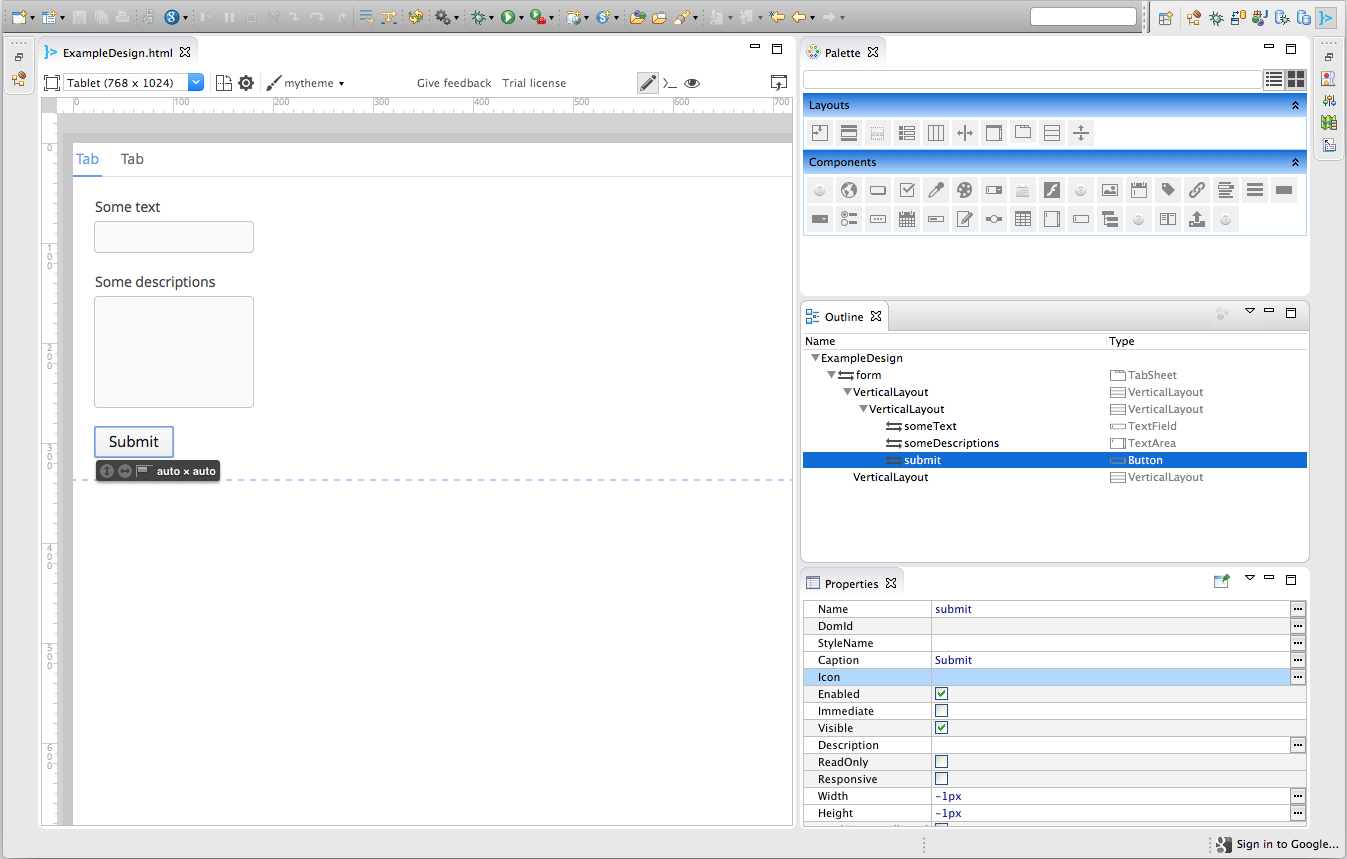
It also allows us to define the UI frames using Declarative UI Design in XML with Addon Clara. It also has a visual designer ( WYSIWYG ):

By the way, if you are interested, we leave here a few links:
And finally, here you can get the slides and video of the presentation:


Enjoy !!!!

domingo, 2 de febrero de 2014

Introduction to Vaadin (6/2)

Talk in English

Hello community !

February is here so, here we are ! Our next event, next thursday 6th of february will focus on a great open source application framework: Vaadin.


For all of you who don't know anything about Vaadin, we can tell you that is an great framework built on top of open source technologies designed to build rich Internet applications. It uses a server-side architecture to build & deliver Javascript to the browser, so it means that all of your application logic runs on your servers. Of course, it uses Ajax requests to provide a rich and interactive user experience. Writing an application that lazily loads large amounts of data from the server, includes drag-and-drop, keyboard navigation and compelling visualizations would not require writing any HTML, JavaScript or resigning a REST API. While the server centric development model provides the best productivity, Vaadin also supports client-side development though the GWT based Java to JavaScript compiler as well as JavaScript. The default looks of the application can be customized with CSS and SASS.


This presentation will give you an overview to Vaadin and explain how it works. We'll also discuss on what are the latest new features of Vaadin and how the roadmap looks. The session should give you everything you need to get started building your own apps with the free Apache-licensed Vaadin. Furthermore, we explore the ways of combining the server- and client-side development models in the context of Vaadin Framework and GWT. The goal is to be able to use the best of the both models and provide a flexible basis for building high quality user interfaces for enterprise applications. 

We invite you to take a look at their website, it's really interesting the amount of features it has. Check out the sampler app they have in their website and you will see how beautiful and rich UI you can build as well as how easy is the code to understand and write. 

Dr. Joonas Lehtinen, founder and CEO of Vaadin ltd, the company behind the Vaddin framework, will come from Finland to explain which are the benefits of work with this web framework and why we must try it in comparison with others. Joonas has been developing applications for the web since 1995 with a strong focus on Ajax and Java and he is a frequent speaker at international conferences.

Nothing more to say guys, come to see what's inside this web framework and don't forget to RSVPed!

See you next thursday!

miércoles, 9 de octubre de 2013

Resumen Play! Framework ( 02 / 10 )

Hola devs !!!!

El pasado 2 de Octubre tuvimos el placer de asistir a una presentación sobre Play Framework a cargo de nuestro colega Fernando García Bernal y en la cual pudimos ver de forma eminentemente práctica cómo desarrollar sencillas aplicaciones web con este framework.


Uno de los principales conceptos nos mostró fue la sencillez con la que se desarrollan los distintos elementos que componen la web usando la convención y no la configuración para conseguir que los controladores y las vistas vayan de la mano.


Fernando nos comentó también la disponibilidad de módulos, o plugins, que existen y que permiten la conexión con diferentes Bases de Datos o conectores externos.

Pudimos conocer que Play ya viene listo para funcionar desde el primer momento incorporando Jetty como motor web y abstracciones a nivel de JPA para acceso a datos que lo hacen muy sencillo.

Por otro lado vimos la consola de Play y lo fácil que es crear automáticamente los CRUDs a partir de las entidades del modelo de nuestro proyecto .

Tal vez si hay alguna pega podría ser la baja integración, al menos con el entorno de la charla, que hay entre el fichero de configuración de Play y nuestras clases usando Eclipse.


Aquí os dejo la presentación http://bit.ly/fegabe-play y el video en nuestro canal de Youtube.


Un saludo.

jueves, 26 de septiembre de 2013

Do you want to Play?... Let's talk about Play Framework! (02/10)

Hola de nuevo!

Ya tenemos aquí nuestra siguiente charla (¡sí, sí, esto es un no parar!). Este próximo miércoles día 2 a partir de las 19h y de la mano de Fernando García Bernal nos introduciremos en uno de esos grandes frameworks de los algunos hemos oído hablar en más de una ocasión: Play Framework.

Para quien no lo conozca, decir que Play Framework es un marco de trabajo web de código abierto, escrito tanto en Scala como en Java que sigue el patrón MVC para facilitar el desarrollo de aplicaciones web y que destaca principalmente por su sencillez de uso. Entre otras, intenta optimizar la productividad de los desarrolladores, a través de la aplicación de conceptos como la convención sobre configuración, evitando redeployments y redespliegues y optimizando la visualización de errores de forma rápida y directa para el desarrollador.

En cuanto a nuestro ponente, Fernando, se dedica al desarrollo móvil para Android e iOS desde hace años y actualmente trabaja como freelance donde ha colaborado con varias startups desarrollando tanto aplicaciones móviles como su correspondiente API. 

En cuanto a cómo hemos planteado la charla, crearemos un proyecto desde cero donde podremos ver las características principales para terminar comentando las ventajas e inconvenientes de usar este framework en lugar de otros. De esta forma, primero Fernando nos hará una introducción de Play para seguidamente crear, paso a paso, una API básica desde cero, comentando las partes más importantes de éste. Por último, acabaremos preguntándonos si Play es el framework más adecuado con el que me debería "casarme" en mis proyectos.

Así pues, si estás pensando en cómo construir una API o tienes interés en cómo funciona Play, no lo dudes y vente el próximo miércoles a la Fontana.

Te esperamos!